

Your business and economy news reporter
Provided by AGP
RFID Electronic Toll Collection System Market to Reach US$11.9 Billion by 2033 at 10.2% CAGR Growth
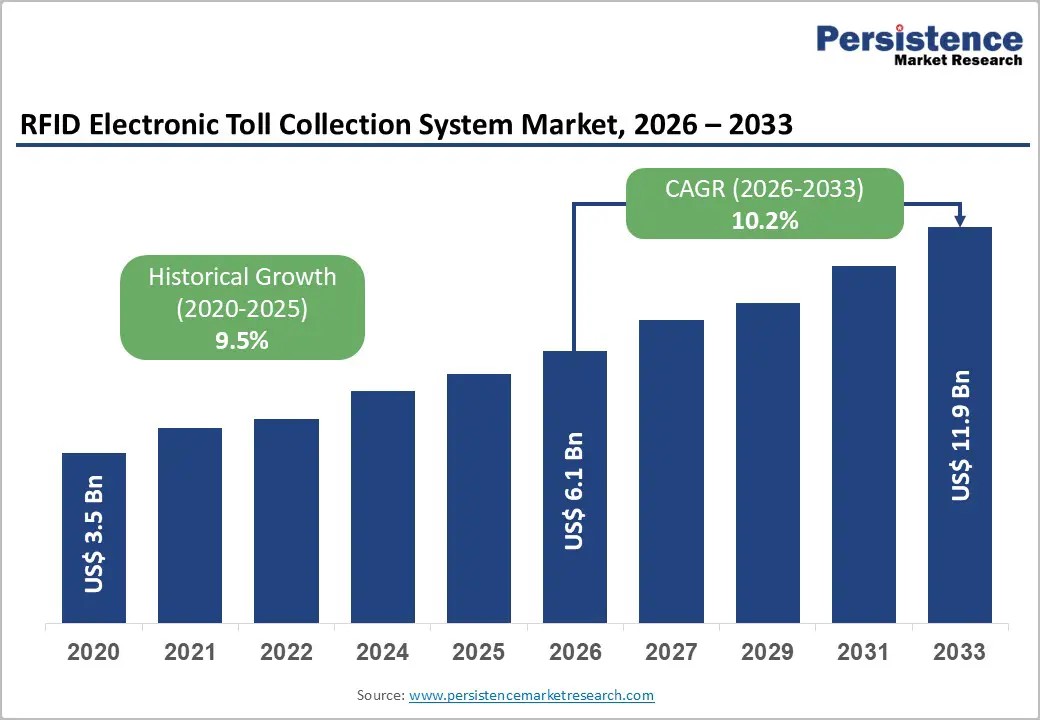
RFID electronic toll market will from US$6.1 Bn in 2026 to US$11.9 Bn by 2033, driven by urban congestion, cashless toll mandates& smart transport investments
BRENTFORD, ENGLAND, UNITED KINGDOM, May 4, 2026 /EINPresswire.com/ -- The global RFID Electronic Toll Collection (ETC) System Market is growing steadily, rising from US$ 6.1 billion in 2026 to US$ 11.9 billion by 2033 at a CAGR of 10.2%. Growth is driven by rapid urbanization, heavy traffic congestion affecting 71% of major cities, and strong investments of over US$ 428 billion in smart transport infrastructure. Expanding vehicle numbers and the shift toward cashless, automated tolling systems are further boosting demand.
RFID-based tolling improves traffic flow by up to 300% and reduces emissions by around 35%, making it a key smart mobility solution. Hardware leads the market, while highways dominate applications with 56% share. Asia Pacific holds the largest regional share at 36%, followed by North America and Europe, supported by strong infrastructure upgrades and regulatory support.
𝐆𝐞𝐭 𝐚 𝐒𝐚𝐦𝐩𝐥𝐞 𝐏𝐃𝐅 𝐁𝐫𝐨𝐜𝐡𝐮𝐫𝐞 𝐨𝐟 𝐭𝐡𝐞 𝐑𝐞𝐩𝐨𝐫𝐭: https://www.persistencemarketresearch.com/samples/31381
Market Segmentation
The RFID Electronic Toll Collection System Market is segmented into components, toll charge types, and applications, each playing a key role in market growth. By components, hardware leads the market due to extensive use of RFID tags, antennas, and readers, while software is gaining traction with cloud platforms, AI analytics, and real-time toll management. Services such as integration and maintenance support system scalability and smooth operations.
Based on toll charge type, distance-based tolling is the most widely used as it ensures fair, usage-based pricing. Point-based tolling is growing in urban congestion zones to control traffic flow, while time-based tolling is emerging in cities to discourage peak-hour travel. From an application perspective, highways dominate due to high-speed intercity transport efficiency, while urban roads are growing rapidly with smart city initiatives. Bridges and tunnels also play a key role in high-density areas requiring traffic optimization.
Regional Insights
North America holds a strong position in the RFID Electronic Toll Collection System Market, driven by widespread adoption of all-electronic tolling and systems like E-ZPass. Strong infrastructure investments, highway privatization, and government efforts to reduce congestion are accelerating the shift toward fully cashless tolling, with the U.S. leading regional adoption.
Europe is a mature, regulated market supported by EU interoperability mandates. Countries such as Germany, France, and the UK are deploying advanced tolling systems, while sustainability goals are driving congestion pricing in cities like London and Stockholm, along with growing cross-border integration.
Asia Pacific dominates the global market, fueled by rapid urbanization and large-scale highway expansion. China leads with extensive expressway networks and high ETC adoption, while India’s FASTag system has improved toll efficiency significantly. Japan, South Korea, and Southeast Asia are also expanding smart tolling, supported by cost-effective RFID manufacturing.
𝐃𝐨 𝐘𝐨𝐮 𝐇𝐚𝐯𝐞 𝐀𝐧𝐲 𝐐𝐮𝐞𝐫𝐲 𝐎𝐫 𝐒𝐩𝐞𝐜𝐢𝐟𝐢𝐜 𝐑𝐞𝐪𝐮𝐢𝐫𝐞𝐦𝐞𝐧𝐭? 𝐑𝐞𝐪𝐮𝐞𝐬𝐭 𝐂𝐮𝐬𝐭𝐨𝐦𝐢𝐳𝐚𝐭𝐢𝐨𝐧 𝐨𝐟 𝐑𝐞𝐩𝐨𝐫𝐭: https://www.persistencemarketresearch.com/request-customization/31381
Market Drivers
One of the primary drivers of the RFID Electronic Toll Collection System Market is escalating traffic congestion caused by rapid urbanization and rising vehicle ownership. Traditional toll collection methods contribute significantly to delays, fuel wastage, and environmental pollution. RFID-based systems eliminate the need for manual stopping, improving traffic flow and reducing congestion at toll plazas. Governments are increasingly adopting these systems to enhance mobility efficiency and reduce economic losses caused by traffic delays.
Another key driver is the expansion of smart city initiatives and intelligent transportation systems. Governments worldwide are investing heavily in digital infrastructure to modernize transportation networks. RFID-based tolling aligns with these initiatives by enabling automated, data-driven traffic management. Additionally, regulatory mandates promoting cashless tolling and interoperability across regions are accelerating adoption. The integration of RFID systems with connected vehicle technologies and 5G networks is further enhancing operational capabilities and enabling real-time mobility services.
Market Restraints
Despite strong growth potential, the RFID Electronic Toll Collection System Market faces certain restraints, primarily related to high implementation costs and infrastructure complexity. Deployment of RFID-based toll systems requires significant investment in roadside equipment, backend systems, and enforcement infrastructure. These high upfront costs can limit adoption, particularly in developing regions or low-traffic corridors where return on investment is slower.
Another major restraint is data privacy and cybersecurity concerns. RFID systems track vehicle movements, raising concerns about user surveillance and data misuse. Increasing incidents of cyberattacks and data breaches in transportation networks further amplify these concerns. Compliance with strict data protection regulations adds operational costs and complexity for system operators, potentially slowing down widespread adoption in some regions.
Market Opportunities
The integration of RFID toll systems with connected vehicle technologies and vehicle-to-everything (V2X) communication presents a major growth opportunity. These advancements enable dynamic toll pricing, real-time traffic optimization, and seamless integration with mobility services such as parking and fuel payments. As connected vehicles become more widespread, RFID-based toll systems will evolve into broader mobility platforms offering value-added services.
Another significant opportunity lies in the transition toward distance-based road usage charging systems. As fuel tax revenues decline due to electric vehicle adoption, governments are exploring mileage-based tolling models. RFID systems integrated with GPS and smart infrastructure can enable precise distance tracking and fair pricing mechanisms. This shift is expected to expand the scope of tolling systems beyond highways to entire road networks, unlocking long-term revenue opportunities.
𝐁𝐮𝐲 𝐍𝐨𝐰 𝐭𝐡𝐞 𝐃𝐞𝐭𝐚𝐢𝐥𝐞𝐝 𝐑𝐞𝐩𝐨𝐫𝐭: https://www.persistencemarketresearch.com/checkout/31381
Company Insights
• Kapsch TrafficCom AG
• Thales Group
• TransCore (Roper Technologies)
• Conduent Transportation
• Neology, Inc.
• Q-Free ASA
• Verra Mobility Corporation
• Siemens Mobility
• Cubic Transportation Systems
• Far Eastern Electronic Toll Collection Co.
• Xerox Corporation
• EfkON AG
• Mitsubishi Heavy Industries
• Raytheon Company
• Smartrac Technology Group
Conclusion
The RFID Electronic Toll Collection System Market is undergoing a transformative shift driven by smart transportation initiatives, rapid urbanization, and increasing demand for efficient mobility solutions. As governments and transportation agencies prioritize congestion reduction and digital infrastructure modernization, RFID-based tolling systems are becoming essential components of intelligent transport ecosystems. With strong growth prospects across both developed and emerging regions, continued innovation in connectivity, automation, and integrated mobility services will shape the future of toll collection systems, making them more efficient, scalable, and user-centric.
Related Reports:
Cloud Telephony Service Market
Pooja Gawai
Persistence Market Research
+1 646-878-6329
email us here
Visit us on social media:
LinkedIn
Instagram
Facebook
YouTube
Legal Disclaimer:
EIN Presswire provides this news content "as is" without warranty of any kind. We do not accept any responsibility or liability for the accuracy, content, images, videos, licenses, completeness, legality, or reliability of the information contained in this article. If you have any complaints or copyright issues related to this article, kindly contact the author above.
