

North America Boat Trailer Market: A USD 1.48 Billion Horizon by 2035
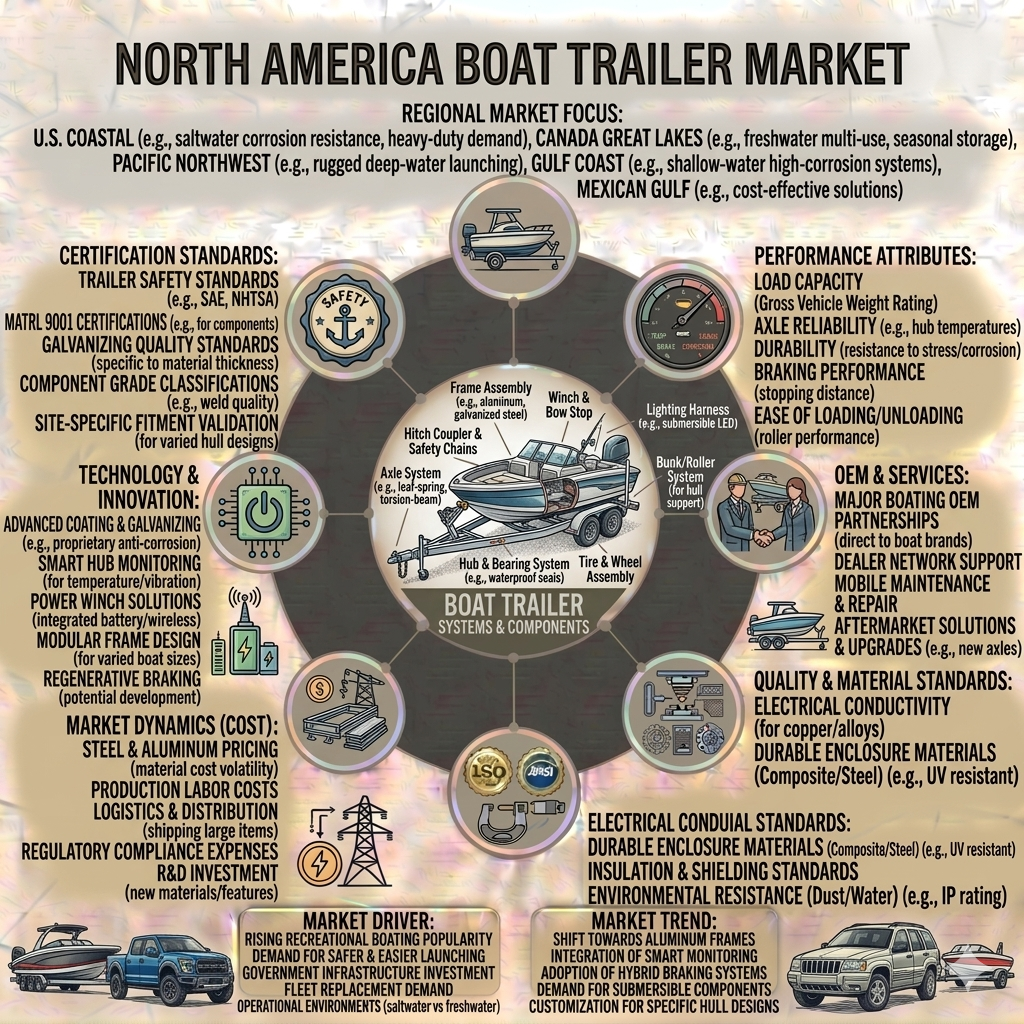
North America Boat Trailer Market
North America boat trailer demand is anticipated to reach from USD 857.1 million in 2025 to approximately USD 1,478 million by 2035
NEWARK, DE, UNITED STATES, April 2, 2026 /EINPresswire.com/ -- The North American recreational boating industry is steering toward a decade of significant expansion. New strategic market data reveals that the North America Boat Trailer Market is valued at USD 857.1 million in 2025 and is projected to reach USD 1,478 million by 2035, expanding at a steady CAGR of 5.6%.
This growth represents an absolute value increase of USD 618.7 million, fueled by a cultural shift toward outdoor recreation, rising middle-income boat ownership, and a critical move toward advanced, corrosion-resistant materials.
Material Revolution: The Shift to Aluminum
The most significant trend in modern boat transportation is the transition from traditional steel to aluminum. Aluminum trailers are projected to capture 52% of the market share by 2025.
The pivot toward aluminum is driven by three mechanical advantages:
1. Corrosion Resistance: Essential for the Atlantic, Pacific, and Gulf Coast regions where saltwater exposure quickly degrades galvanized or painted steel.
2. Weight Efficiency: Aluminum’s lightweight nature improves the fuel economy of towing vehicles (trucks and SUVs) and allows for higher vessel payloads.
3. Longevity: While the initial investment is higher, the reduced maintenance and extended service life provide superior long-term value for boaters.
Get Access of Report Sample:
https://www.futuremarketinsights.com/reports/sample/rep-gb-19073
Segment Insights: Bunk Trailers and Mid-size Vessels
The market architecture is currently dominated by two primary segments that reflect the "average" North American boater's needs.
• Bunk Trailers (58.0% Share): Preferred for their simplicity and superior hull protection. Modern designs feature adjustable carpeted bunks that act as a cradle, distributing the boat's weight evenly to prevent structural stress during long-distance transport.
• Mid-size Boats (45% Share): Vessels ranging from 20 to 30 feet—including family cruisers, pontoons, and center-console fishing boats—represent the heart of the market. These boats require sophisticated dual-axle trailers equipped with independent torsion suspensions and integrated braking systems to ensure safety at highway speeds.
The Technology of Safety: Braking and Suspension
As recreational vessels become larger and heavier, trailer engineering has evolved beyond simple frames. Manufacturers are increasingly integrating:
• Surge and Electric-over-Hydraulic Brakes: Providing the stopping power necessary for heavy fiberglass and aluminum hulls.
• Torsion Axle Suspensions: Offering a smoother ride compared to traditional leaf springs, which protects sensitive onboard electronics and engine components from road vibration.
• LED Waterproof Lighting: Replacing incandescent bulbs to ensure regulatory compliance and long-term reliability after frequent submersions.
Regional Growth: Mexico and the United States Lead
While the market is growing across the continent, the pace varies by country based on tourism development and infrastructure maturity.
The North American and Latin American boat trailer markets are experiencing diverse growth trajectories, led by Mexico with a projected 6.2% CAGR through 2035, fueled by rapid coastal tourism development in regions like Quintana Roo and Baja California. Brazil follows with a 5.6% CAGR, supported by a strong recreational fishing culture and the utilization of its extensive inland waterway networks. In the United States, a 5.4% CAGR is anticipated, underpinned by a deep-rooted recreational boating culture and a highly established network of marine dealerships. Canada is expected to expand at a 5.0% CAGR, driven by seasonal marine tourism and the continued growth of waterfront properties in "cottage country" regions. Finally, Argentina shows a steady 4.8% CAGR, with demand concentrated in riverine and lake-based recreation within the Tigre Delta and Patagonia areas.
Competitive Landscape: The Tier-1 Suppliers
The North American market is highly competitive, characterized by specialized manufacturers with deep engineering roots.
• Load Rite Trailers Inc. & EZ Loader: Lead with extensive distribution networks through marine dealerships, offering both bunk and roller configurations.
• Karavan Trailers & Magic Tilt: Focus on technological innovation, specifically in welded I-beam aluminum frames and multi-vessel compatibility.
• Magnum Trailers Inc.: Specializes in heavy-duty, custom solutions for oversized vessels and professional-grade transportation.
Frequently Asked Questions (FAQ)
1. Why are Bunk trailers more popular than Roller trailers in North America?
Bunk trailers are generally more cost-effective and provide better support for the boat’s hull by spreading the weight over a larger surface area. They are ideal for float-on launching in areas with well-maintained ramps. Roller trailers are typically reserved for shallow-water launches where the boat must be rolled off.
2. Does a 25-foot boat always require a dual-axle trailer?
Usually, yes. Once a boat and its fuel/gear exceed roughly 3,500 lbs, a dual-axle trailer is required for stability, weight distribution, and to meet safety regulations regarding braking capacity.
3. What is the benefit of a "torsion axle" over "leaf springs"?
Torsion axles use rubber cords inside the axle tube to provide suspension. They have fewer moving parts to corrode, provide a much smoother ride, and allow the trailer to sit lower to the ground for easier launching.
4. Why is aluminum preferred for saltwater even if it’s more expensive?
Galvanized steel is coated to resist rust, but any scratch or salt ingress can lead to "spidering" rust. Aluminum naturally forms an oxide layer that prevents deep corrosion, making it almost impervious to the damaging effects of saltwater.
5. How often should boat trailer wheel bearings be serviced?
Because boat trailers are submerged in water, wheel bearings should be inspected and greased at least once a year, or every 2,000 miles, to prevent "bearing failure" on the highway.
Browse More Industry Reports :
North America Travel Trailers Market
https://www.futuremarketinsights.com/reports/north-america-travel-trailers-sector-analysis-and-forecast
Boat Trailers Market
https://www.futuremarketinsights.com/reports/boat-trailer-market
North America Mailer Market
https://www.futuremarketinsights.com/reports/north-america-mailer-market
Sudip Saha
Future Market Insights Inc.
+1 347-918-3531
email us here
Legal Disclaimer:
EIN Presswire provides this news content "as is" without warranty of any kind. We do not accept any responsibility or liability for the accuracy, content, images, videos, licenses, completeness, legality, or reliability of the information contained in this article. If you have any complaints or copyright issues related to this article, kindly contact the author above.
