

Bio-Based 1,4-Butanediol Market Forecast 2026–2036: Market to Reach USD 780 Million by 2036 at 14.0 % CAGR
Bio-Based 1,4-Butanediol Market
THF production accounts for approximately 38% share, serving as a vital precursor for engineering polymers.
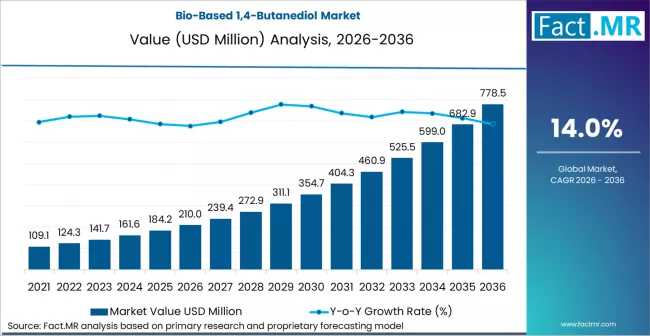
ROCKVILLE, MD, UNITED STATES, February 22, 2026 /EINPresswire.com/ -- The global bio-based 1,4-butanediol market is projected to reach a valuation of USD 210 million in 2026, expanding significantly to USD 780 million by 2036. This growth, characterized by a CAGR of 14.0%, is driven by the accelerating downstream acceptance of bio-based intermediates across polymer, resin, and solvent value chains. As lifecycle carbon performance and feedstock diversification become central to procurement criteria, the market is set to add approximately USD 596 million in absolute value over the next decade.Get Access of Report Sample: https://www.factmr.com/connectus/sample?flag=S&rep_id=14324
Bio-Based 1,4-Butanediol Market Snapshot
Market size 2026? USD 210 million.
Market size 2036? USD 780 million.
CAGR? 14.0% (2026–2036).
Leading product segment and share? Technical Grade leads the market with a 52% share due to its suitability for large-volume chemical synthesis.
Leading application and share? THF production accounts for approximately 38% share, serving as a vital precursor for engineering polymers.
Key growth regions? The United States (14.5% CAGR) and China (13.8% CAGR) are the primary growth engines.
Top companies? Novamont S.p.A., BASF SE, Genomatica Inc., LCY Chemical Corp., and Dairen Chemical Corp.
Market Momentum (YoY Path)
The market trajectory demonstrates structurally compounding growth:
2025: USD 184 million (Base Year)
2026: USD 210 million
2028: USD 273 million
2030: USD 355 million
2031: USD 404 million
2033: USD 525 million
2036: USD 780 million
Why the Market is Growing
The expansion of the Bio-Based 1,4-Butanediol Market is fueled by improving substitution economics versus petrochemical alternatives as fermentation yields stabilize. Additionally, the expansion of downstream THF and PBT resin capacities is increasing the necessity for technically consistent bio-based inputs. Furthermore, stringent chemical registration and reporting oversight under U.S. regulatory programs are shaping plant-level capacity decisions and commercialization paces.
Segment Spotlight
1) Grade Type
Technical Grade material is estimated to hold 52% of the global market. This dominance is attributed to its alignment with manufacturer needs for cost efficiency and process compatibility in industrial environments. It is preferred in continuous chemical synthesis operations where volume demand outweighs the need for ultra-high pharmaceutical purity.
2) Application
Tetrahydrofuran (THF) production accounts for a 38% market share. THF serves as a critical primary downstream pathway for the production of polytetramethylene ether glycol and various engineering polymers. This application requires large-volume, stable feedstock quality, positioning bio-based BDO as a key sustainable alternative.
3) End Use
The market is heavily influenced by the Plastics & Polymers and Automotive sectors. Bio-based BDO supports the manufacturing of polybutylene terephthalate (PBT) and thermoplastic polyurethanes (TPU). Growth in these sectors is driven by corporate sustainability targets and the need for reduced carbon footprint attributes in supply chains.
Drivers, Opportunities, Trends, and Challenges
Drivers: The primary driver is the shift toward sustainability procurement. Corporate demand for bio-based intermediates in elastomers and polymers supports the selective adoption of the Bio-Based 1,4-Butanediol Market in global supply chains aiming for decarbonization.
Opportunities: Advancements in fermentation technology and scale-up projects present significant opportunities. As yield stability improves, producers can secure long-term offtake agreements with solvent and polymer manufacturers, de-risking large-scale investments in biorefineries.
Trends: A key trend is the integration of bio-based BDO into established chemical manufacturing systems. Producers are increasingly focusing on multi-feedstock flexibility and downstream purification to ensure product consistency and multi-region regulatory compliance.
Challenges: High production costs compared to petrochemical routes remain a restraint. Bio-based BDO often carries premium pricing due to process complexity and separation requirements; however, this cost dynamic is currently supported by sustainability-driven market value growth.
Country Growth Outlook (CAGR)
Country CAGR (2026-2036)
United States 14.5%
China 13.8%
Germany 12.2%
Japan 10.5%
Competitive Landscape
The Bio-Based 1,4-Butanediol Market is characterized by players focusing on production efficiency and regulatory compliance. Novamont S.p.A. and BASF SE lead through large-scale fermentation capabilities. Genomatica Inc. utilizes proprietary microbial pathways for yield optimization, while LCY Chemical Corp. and Dairen Chemical Corp. emphasize feedstock flexibility to maintain product consistency across various industrial clusters.
To View Related Report :
Bio-based Coating Market https://www.factmr.com/report/1048/bio-based-coatings-market
Bio-based Pigments and Dyes Market https://www.factmr.com/report/1050/bio-based-pigments-and-dyes-market
Bio-identical Hormones Replacement Therapy Market https://www.factmr.com/report/1137/bio-identical-hormones-replacement-therapy-market
Bio-Based Acetic Acid Market https://www.factmr.com/report/1189/bio-based-acetic-acid-market
About Fact.MR
We are a trusted research partner of 80% of fortune 1000 companies across the globe. We are consistently growing in the field of market research with more than 1000 reports published every year. The dedicated team of 400-plus analysts and consultants is committed to achieving the utmost level of our client's satisfaction.
S. N. Jha
Fact.MR
+1 628-251-1583
email us here
Legal Disclaimer:
EIN Presswire provides this news content "as is" without warranty of any kind. We do not accept any responsibility or liability for the accuracy, content, images, videos, licenses, completeness, legality, or reliability of the information contained in this article. If you have any complaints or copyright issues related to this article, kindly contact the author above.
