

In Situ Atomic Force Microscopy Reveals the Stabilization Mechanism for Lithium Metal Batteries
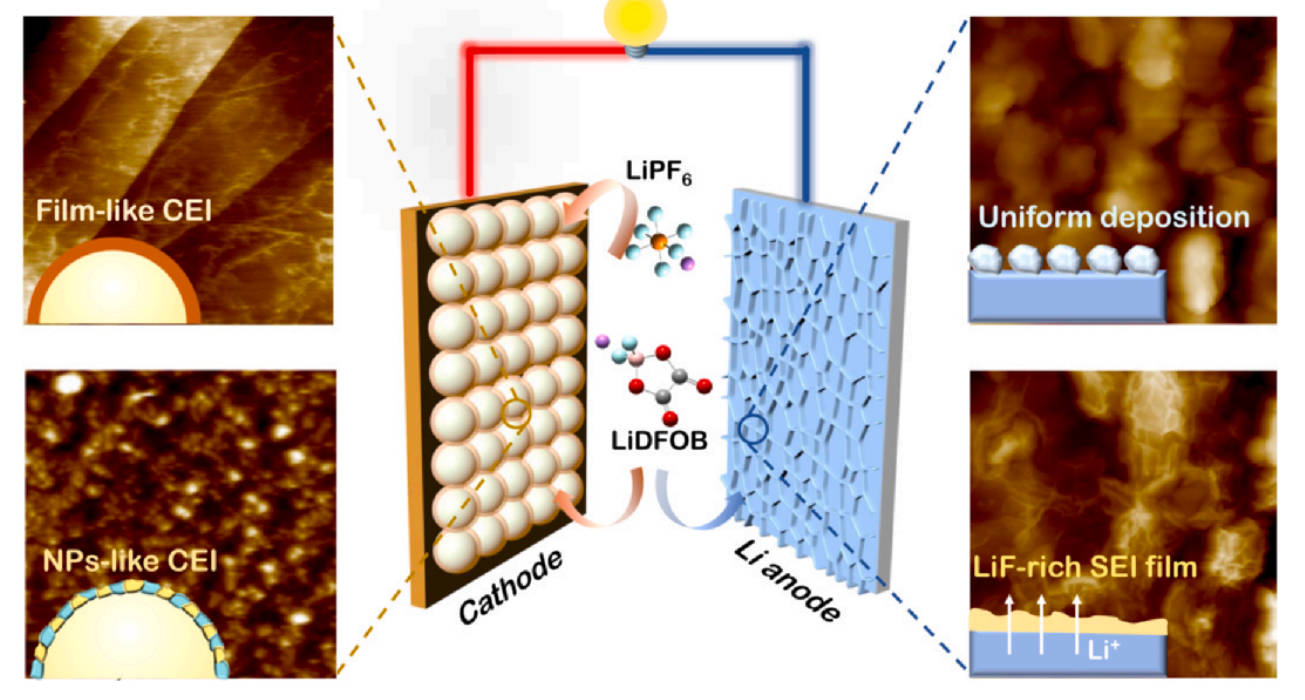
Dual-salt regulated interfacial evolution at cathode and anode in lithium metal batteries.
GA, UNITED STATES, December 23, 2025 /EINPresswire.com/ -- Lithium metal batteries hold potential for next-generation energy storage, but interfacial instability limits their long-term performance. This study shows how combining LiDFOB and LiPF₆ in a dual-salt electrolyte can regulate electrode–electrolyte interphase (EEI) at both cathode and anode. Using in situ electrochemical atomic force microscopy (EC-AFM), researchers visualized the real-time formation of a bilayer cathode electrolyte interphase (CEI) on NCM622 cathode and a LiF-rich solid electrolyte interphase (SEI) on lithium metal anode. These compact EEI films help reduce impedance, enable more uniform Li deposition, and improve cycling stability. The work offers direct evidence of interface evolution during operation, providing a guidance for the optimal design to construct a stable electrode/electrolyte interface in lithium metal batteries.
Lithium metal batteries are valued for high energy density, yet their practical use is restricted by unstable electrode/electrolyte interfaces. Layered oxide cathodes can undergo electrolyte decomposition and metal dissolution, while lithium metal anodes face dendrite formation and fragile SEI layers. Interfacial film-forming electrolyte additives have been developed to stabilize interfaces, and dual-salt additives could modify the EEI chemistry. Understanding how interphases grow and evolve in real time is therefore important for improving both performance and safety. Due to these challenges, approaches capable of stabilizing cathode and anode interfaces concurrently require further investigation.
Researchers at the Institute of Chemistry, Chinese Academy of Sciences, reported (DOI: 10.1016/j.esen.2025.100004) in eScience Energy (2025) an in situ electrochemical atomic force microscopy (EC-AFM) study on how dual lithium salts regulate electrode interfaces in working lithium metal batteries. By tracking NCM622 cathodes and lithium anodes during charge and discharge, the team observed a double-layer cathode electrolyte interphase (CEI) on the cathode and a LiF-rich solid electrolyte interphase (SEI) on the anode. The dual-salt system demonstrated reduced interfacial resistance and more stable cycling performance compared with single-salt electrolytes.
The researchers formulated three liquid electrolytes—LiPF₆, LiDFOB, and dual-salt—and monitored interface evolution through in situ EC-AFM. On the cathode, LiDFOB first formed a thin interphase film, followed by LiPF₆-derived nanoparticle deposition, resulting in a double-layer CEI. X-ray photoelectron spectroscop (XPS) spectra showed B- and F-containing species within the interphase, verifying salt participation in CEI growth. At the Li anode, homogenous Li deposition and shrinkage dissolution were observed, accompanied by a uniform and flexible SEI formation in the presence of LiDFOB, which accommodated volume fluctuations and helped suppress dendrite development. Without LiDFOB, Li deposition became irregular and left hole-like defects. Electrochemical tests showed 82% capacity retention after 200 cycles at 0.5C in dual-salt cells, compared with significantly lower retention in single-salt systems. Symmetric Li/Li cells maintained stable overpotential over 300 hours, indicating improved interface stability. EIS–DRT analysis further confirmed lower impedance and smoother ion transport.
“Our observations show that LiDFOB and LiPF₆ function cooperatively rather than independently,” the authors explain. LiDFOB facilitates initial film formation, while LiPF₆ promotes nanoparticle growth to reinforce the CEI. They note that this coordinated process contributes to reduced interfacial resistance and improved reversibility during cycling. The researchers suggest that real-time visualization of interphase evolution provides a useful basis for electrolyte design and could support broader development of lithium metal batteries under practical operating conditions.
The work demonstrates a dual-salt electrolyte strategy for stabilizing interfaces in lithium metal batteries by forming a double-layer CEI at the cathode and a LiF-rich SEI at the anode. This design lowers interfacial impedance, promotes uniform Li deposition, and enhances durability under cycling. Because the formulation is compatible with conventional liquid systems, it may be extended to other high-voltage cathodes or applied to next-generation battery configurations. The authors suggest that optimizing salt ratios, interaction pathways, and long-term stability could support further performance improvement toward scalable applications.
DOI
10.1016/j.esen.2025.100004
Original Source URL
https://doi.org/10.1016/j.esen.2025.100004
Funding information
This work was financially supported by the National Natural Science Foundation of China (Grant Nos. 92372125, 22425403, 22421001) and the Strategic Priority Research Program of the Chinese Academy of Sciences (Grant No. XDB1040300).
Lucy Wang
BioDesign Research
email us here
Legal Disclaimer:
EIN Presswire provides this news content "as is" without warranty of any kind. We do not accept any responsibility or liability for the accuracy, content, images, videos, licenses, completeness, legality, or reliability of the information contained in this article. If you have any complaints or copyright issues related to this article, kindly contact the author above.
