

New kinetic-tuning strategy unlocks near-theoretical capacity of Li-rich cathodes for Li-ion batteries
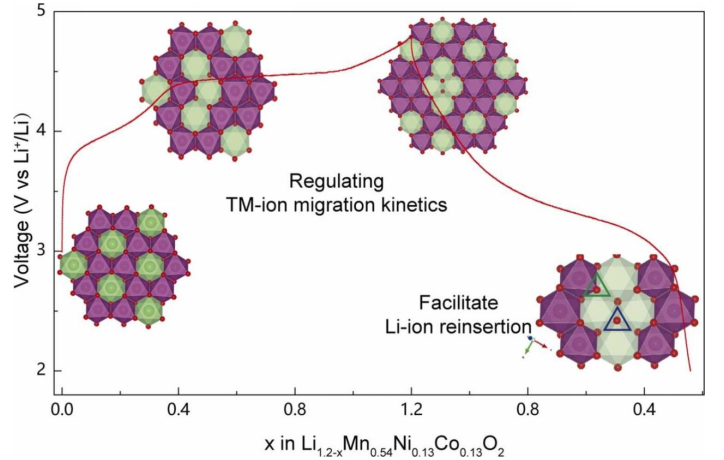
Regulating transition-metal migration to enhance Li-ion reinsertion.
FAYETTEVILLE, GA, UNITED STATES, December 23, 2025 /EINPresswire.com/ -- High-energy-density lithium-ion batteries are essential for next-generation electric vehicles and energy storage systems. However, Li-rich cathodes often underperform due to sluggish lithium reinsertion and irreversible capacity loss. This study introduces a kinetic activation strategy that regulates in-plane transition-metal (TM) ion migration and triggers controlled local structural rearrangements. By promoting lattice oxygen activation and enhancing Li-ion reinsertion kinetics, the team achieved reversible Li storage beyond 1.1 mol, reaching 348 mAh g⁻¹, close to theoretical limits. The work reveals a direct link between TM migration, lattice oxygen redox, and Li-ion mobility, offering a new pathway toward high-energy-density battery cathodes.
Li-rich layered cathodes offer high theoretical capacity through combined cationic and anionic redox. Yet practical utilization remains below expectations: Li reinsertion is often sluggish, oxygen redox is partially irreversible, and voltage hysteresis leads to capacity decay. Only ~75% of Li typically participates in cycling, restricting energy output. Prior research indicates oxygen redox activity is strongly linked to transition-metal (TM) migration and local coordination environments, but how migration kinetics influence bulk oxygen activation and reinsertion pathways remains poorly understood. Due to these challenges, in-depth investigation into cation migration–oxygen redox coupling is required to achieve full cathode capacity utilization.
Researchers from the Institute of Chemistry, Chinese Academy of Sciences, Jilin University, and the National Center for Nanoscience and Technology reported (DOI: 10.1016/j.esen.2025.100002) on October 23, 2025, in eScience Energy, a study demonstrating that regulating in-plane TM migration enables earlier lattice oxygen activation and improves Li-ion reinsertion kinetics. The approach allowed reversible lithium storage beyond the long-standing 1.1 stoichiometric limit in Li-rich cathodes, with the optimized KA-O-LMR delivering 348 mAh g⁻¹, approaching near-theoretical capacity under practical cycling conditions.
Using atomic-resolution high-angle annular dark-field scanning transmission electron microscopy (HAADF-STEM) imaging, the team visualized in-plane TM migration during charging, observing progressive rearrangements that generated Li-vacancy clusters within the TM layer. DFT simulations confirmed that such rearrangements lower the migration energy and modify oxygen coordination, enhancing anionic redox activity. To accelerate this process, researchers introduced oxygen vacancies via molten-salt synthesis and ammonia treatment, creating an O-LMR cathode with higher vacancy content and faster diffusion kinetics.
Electrochemical testing revealed that oxygen vacancy-rich KA-O-LMR achieved a discharge capacity of 348 mAh g⁻¹ (92.4% of theoretical), surpassing conventional Li-rich materials (typically <280 mAh g⁻¹). dQ/dV profiles and in-situ/ex-situ XPS indicated earlier oxygen redox activation and a larger proportion of oxidized oxygen species after kinetic activation. Li-ion diffusion coefficients also increased significantly, particularly near end-of-discharge, demonstrating improved reinsertion kinetics. NEB calculations showed that rearranged structures create low-barrier lithium migration channels—transforming 6-TM blocking pathways into 1- or 0-TM channels—dramatically reducing energy barriers and enabling rapid Li return to the TM layer.
“Our results show that structural dynamics, not only composition, determine how much lithium a cathode can truly store,” the authors noted. By regulating TM migration, lithium pathways open and lattice oxygen becomes an active charge carrier rather than a limiting factor. The team emphasized that identifying the link between vacancy-cluster formation, anionic redox activation, and reinsertion kinetics provides a design principle that could guide the development of next-generation high-capacity cathodes.
This kinetic-activation approach offers a roadmap toward commercial high-energy cathodes for electric vehicles, portable electronics, and grid-scale storage. By achieving reversible lithium utilization beyond 1.1, Li-rich cathodes can move closer to full theoretical capacity without relying on expensive or scarce metals. Future work may integrate surface stabilization strategies to further suppress voltage decay and enhance cycling life. The findings open opportunities for broader application in anionic-redox electrode systems and inspire structural-engineering designs that push the capacity ceiling of lithium-ion batteries.
References
DOI
10.1016/j.esen.2025.100002
Original Source URL
https://doi.org/10.1016/j.esen.2025.100002
Funding Information
This work was supported by the Basic Science Center Project of National Natural Science Foundation of China (52388201), the National Natural Science Foundation of China (22222904, 22179133 and 12374176), and the Strategic Priority Research Program of the Chinese Academy of Sciences (Grant No. XDB1040100), the Beijing Natural Science Foundation (Grant No. L233004, No. Z220021, No. Z240023), and the Hebei Natural Science Foundation (Grant No. B2024208088).
Lucy Wang
BioDesign Research
email us here
Legal Disclaimer:
EIN Presswire provides this news content "as is" without warranty of any kind. We do not accept any responsibility or liability for the accuracy, content, images, videos, licenses, completeness, legality, or reliability of the information contained in this article. If you have any complaints or copyright issues related to this article, kindly contact the author above.
