

Chinese Neurosurgical Journal Study Provides Insights into the Role of the Brainstem in Disorders of Consciousness
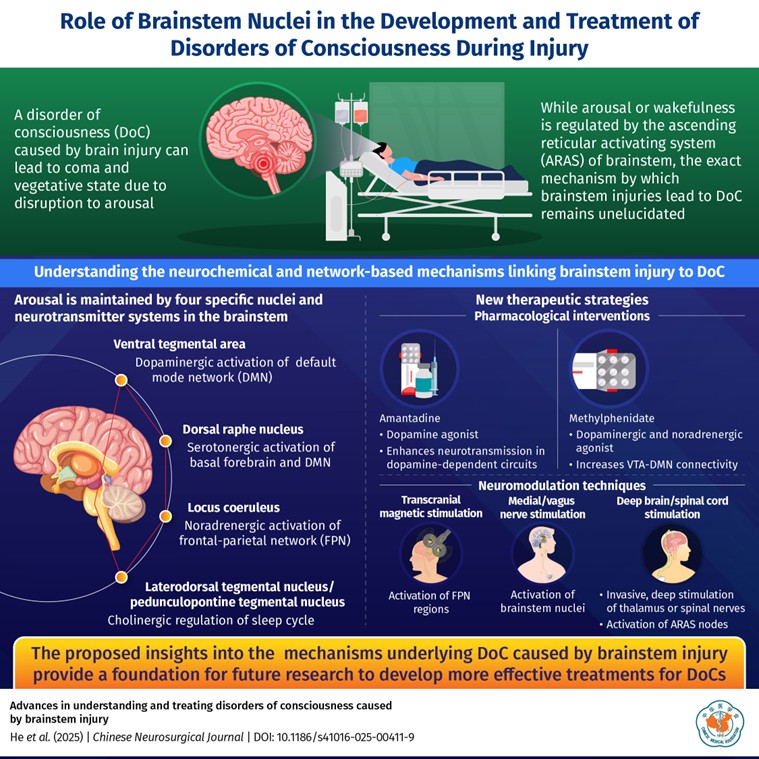
Researchers provide a comprehensive review of the latest research on the anatomical, neurochemical, and network-based mechanisms linking brainstem injury to DoC.
Researchers reveal activation of neurotransmitter networks from the brainstem to cortical regions can aid recovery of consciousness after brain injuries
BEIJING, CHINA, December 10, 2025 /EINPresswire.com/ -- Researchers reveal activation of neurotransmitter networks from the brainstem to cortical regions can aid recovery of consciousness after brain injuriesArousal by the brainstem and subcortical regions, and awareness from cortical regions combine to produce consciousness in the brain. While arousal or wakefulness is regulated by the ascending reticular activating system of brainstem, the exact mechanism by which brainstem injuries lead to disorder of consciousness (DoC) remains unelucidated. Now, researchers reveal the roles of four nodes in the brainstem in DoC, and describe therapies targeting these nodes and their networks to aid recovery.
Consciousness is a specific state of brain activity made up of two dimensions – arousal or wakefulness, and awareness of stimuli. Studies show that arousal is regulated by lower-order regions of the brain—the brainstem’s ascending reticular activating system (ARAS), thalamus, hypothalamus, and basal forebrain—collectively called the subcortical arousal network (SAN). Whereas awareness is controlled by cortical circuits such as the frontal-parietal network (FPN) that responds to external stimuli, and the default mode network (DMN) that is aware of internal stimuli. Together, this is known as the cortical awareness network (CAN).
Interruptions to arousal networks can result in a coma, whereas disruptions to awareness circuitry can result in a vegetative state or minimally conscious state. Collectively, these conditions are called disorders of consciousness (DoC). DoC usually result from traumatic brain injury, hemorrhage, or hypoxic damage after a stroke, each having distinct mechanisms of injury and manifestations of DoC.
Now, a team of researchers led by Professor Yi Yang from the Department of Neurosurgery, Capital Medical University, China, has conducted a review to build a comprehensive picture of the brainstem’s role in consciousness and development of DoC during injury. The study was published online in Volume 11 of Chinese Neurosurgical Journal on 20 October 2025.
“The aim of our study was to provide a comprehensive overview of the current research status and progress on the relationship between the brainstem and DoC, integrating insights from anatomy, neurobiochemistry, brain networks, and therapeutic discoveries to better elucidate the pivotal role of the brainstem in the maintenance and recovery of DoC,” says Prof. Yang.
Drawing from studies of patients with brainstem lesions, as well as animal models of brainstem damage, the team describe the arousal activities of four regions in the ARAS. Firstly,
serotonin secreted by the dorsal raphe nucleus (DRN) activates DMN node. Secondly, norepinephrine secreted by the locus coeruleus (LC) that regulates mood, attention and motivation. Thirdly, dopamine secreted by the ventral tegmental area (VTA) that acts as a connectivity hub between SAN and CAN, especially to DMN nodes. Lastly, laterodorsal and pedunculopontine tegmental nuclei that regulates the sleep cycle.
Notably, disruptions in the brain’s neurotransmitter systems in DoC suggest potential role of neural mediators to restore synaptic conduction and reorganize the homeostasis of brain functional networks.
The researchers reveal different kinds of therapies that can help reactivate ARAS nodes and aid DoC recovery. Compounds that increase activity in dopamine circuits such as amantadine and methylphenidate seem to increase VTA-DMN activity and improve recovery. In addition, magnetic stimulation of cortical networks is primarily used to enhance awareness and motor functions, but they also increase ARAS to cortex neuronal activity. Moreover, stimulation of the vagus nerve can reactivate serotonin and norepinephrine secretion by the DRN and LC. Furthermore, damaged connectivity with brain regions upstream of the ARAS can be partially restored by stimulating upstream regions with electrodes.
“Our study by synthesizing current knowledge on the brainstem’s role in consciousness and highlighting the potential of targeted therapies to improve patient outcomes, paves the way for development of more effective treatments, ultimately contributing to better clinical management and recovery strategies for patients with DoC,” concludes Prof. Yang.
***
Reference
Title of original paper: Advances in understanding and treating disorders of consciousness caused by brainstem injury
Journal: Chinese Neurosurgical Journal
DOI: 10.1186/s41016-025-00411-9
About Capital Medical University
Founded in 1960 as the Beijing Second Medical College, Capital Medical University is one of China’s top medical universities. With 12 colleges and two research centers, the university houses over 7,900 postgraduate and over 7,400 undergraduate students. 21 hospitals in the Beijing region are affiliated with the university. Capital Medical University also houses several National Medical Centers that work closely with national ministries. The university also has exchange and cooperation agreements with 50 universities spanning 20 countries.
Website: https://www.ccmu.edu.cn/index.htm
About Professor Yi Yang from Capital Medical University
Dr. Yi Yang is a Professor at the Department of Neurosurgery, Capital Medical University, China. Her research focuses on brain-computer interface, neuromodulation, and disorders of consciousness. She has over 60 academic publications to her credit. In addition to her research work, she has served as a medical doctor specializing in neurosurgery since 2013.
Funding information
This study was funded by the Science and Technology Innovation 2030 (2022ZD0205300), International (Hong Kong, Macao, and Taiwan) Science and Technology Cooperation Project (Z221100002722014), Chinese Institute for Brain Research Youth Scholar Program (2022-NKX-XM-02), National Natural Science Foundation of China (82371197), Natural Science Foundation of Beijing Municipality (7232049), and Capital Medical University-Yingkang Lifelong Science and Innovation Elite Cultivation Program (2024KCJY0101).
Yi Lu
Chinese Neurosurgical Journal
+861059978478 ext.
luyi617@sina.cn
Legal Disclaimer:
EIN Presswire provides this news content "as is" without warranty of any kind. We do not accept any responsibility or liability for the accuracy, content, images, videos, licenses, completeness, legality, or reliability of the information contained in this article. If you have any complaints or copyright issues related to this article, kindly contact the author above.
